


Pink dolphins are becoming stranded due to drought and human activity. Dr. Enzo Aliaga Rossel led the rescue of 26 dolphins and is now working to build an emergency fund to save more.
DonateThey can be gray, white or bright pink. And the color comes from the capillary that goes near the surface of the skin. So when they have a lot of activity, they become pinker. Like playing, hunting, fishing, mating. It’s like when you make a lot of exercise, you start getting red and you know that’s how they they become so pink. For me, it’s amazing. The mother has to teach the baby somehow through this really muddy and dark waters of the Amazon rivers, how to survive, how what fish to hunt, what dangers to avoid. And that show us that they are very very smart. The babies stay with the mother for more than a year where they’re learning but also they’re drinking milk. They are mammals. So that creates a strong attachment between mother and the baby. So one difference between marine dolphins and rear dolphins is that they have this big forehead. This very prominent forehead full of fat that they use for sonar for navigation. It’s called the melon.
They create a sound that goes and bounces into the prey or trees or anything that is in the way, goes back and hits the melon. And that’s when they interpret all the information and they create this image in the brain. So they can navigate in darkness.
They’re very flexible and they can swim through the forest and move through the trees, make U-turns because their vertebbrates are not fused like marine dolphins. They’re a little bit loose. So that gives them this flexibility and that help them help
all these agricultural changes in the region. They’re changing the main rivers to become irrigation for the crops. So they are taking water from the rivers and the rivers are getting shallow and shallow and they get trapped.
When the rescue happened few years ago, we were able to rescue 26 dolphins. All of them were safe and at the end the all of them were in good shape. We have mother calves, babies all sizes and adults. So it was an entire population. So we went to this remote area by trucks and we had to capture the each individual and that was a lot of work and lot of trouble. So we have to take them out of the water, put them on a stretcher, take them to the tracks that we made nicer with mattresses for the dolphins. So we needed a lot of resources to act quickly. All this rescue in general has a very high cost. The cost of this operation was around $20,000 cuz we stayed there for 15 days with a big big team.
This year was one of the severest droughts in Bolivian history. So, Laaz, the capital of of Bolivia, run out of water. So, people has to make lines to get water. All this lack of rain is caused by climate change. All the glaciers in Bolivia are melting. So, the rivers are going to get and are getting lower and lower. I received information that dolphins are stranded or sometimes they’re dying in on some beaches in the in the rivers in very remote areas and there’s no money to go there. I don’t have the the team to to help me with that and I know that sadly they they died and that’s why we need this this money to to create an emergency fund to be able to react quickly as we receive the information that something is happening. call people, make a team, and go and rescue them. I would like to thank Endangered Species Revenge for all the help and support, and I’m asking you to help me to save the Bolivian pink river dolphin.
The Pink Dolphin’s Remarkable Abilities
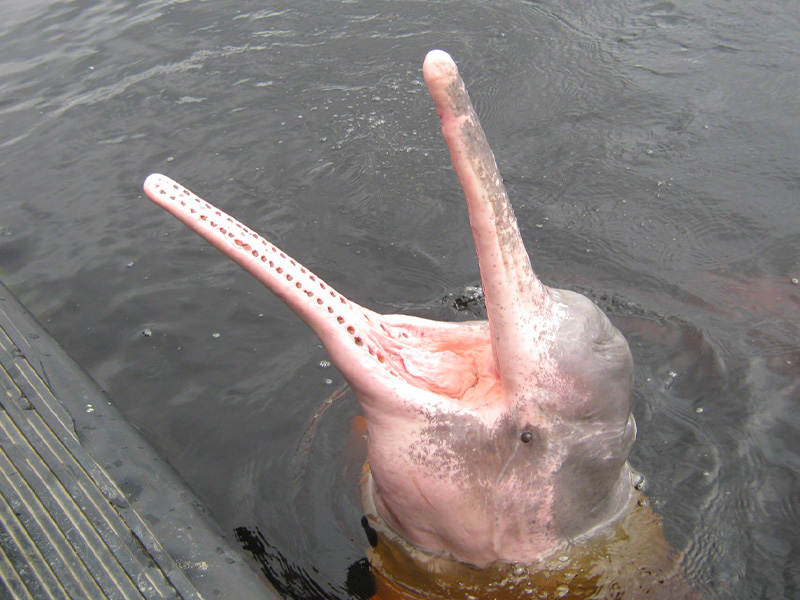
Many people, even animal lovers, are unaware that freshwater river dolphins exist! And the pink river dolphins of Bolivia have fascinating abilities which help them survive the murky brown water of the Amazon River! Right away, something that makes them look different than marine dolphins is their enlarged head—called a melon, which helps them navigate efficiently by echolocation, just like bats. The dolphin emits sound waves which bounce back to the melon after striking an object – and the fat-filled melon interprets what the object is. This enlarged head evolved due to the murky brown water of the Amazon River – as did river dolphin’s smaller eyes, which were of little use.
The Bolivian dolphin’s pink color intensifies with greater physical activity, such as mating, hunting, playing or fishing, just as humans’ cheeks become redder with strenuous exercise. There is a wonderful, close relationship between the mother and her calf. In fact, a calf remains with its mother for nine months, during which the mother teaches her calf everything it needs to know to survive. The fact that the mother is able to teach the calf what foods to eat, what dangers to avoid, and more, all in the brown Amazon River, is evidence of the species’ amazing intelligence. Because they are mammals, the calves drink milk from their mother during this time.
Why Pink Dolphins Are Endangered
Sadly, the pink dolphins of Boliva are critically endangered due to direct human activities, as well as climate change—all of which pollute the Amazon River, and make it shallower.
Sometimes the killing of dolphins is direct—when fishermen kill dolphins who try to eat their catch, sometimes even cutting the dolphins with knives if get entangled in their fishing nets, rather than patiently trying to untangle them.
River pollution by factories, mining, agricultural fertilizer run-off, and other activity impairs the health of dolphins.
But one of the most dangerous threats to pink dolphins today is that the river is becoming more shallow, and doing so more frequently. There are a number of reasons for this.
First, when the Amazon Forest is logged, soil run-off enters the river, making it shallower.
Second, the fast-growing spread of agriculture along riverbeds is imperiling the dolphins because it siphons water away from the river to irrigate inland crops.
And finally, higher temperatures caused by climate change is decreasing river levels.
All of these reasons which make rivers shallower, cause more pink dolphins to die from beaching each year.
Dr. Enzo Aliaga Rossel’s Emergency Rescue Effort
Dr. Rossel’s passionate efforts to save Bolivia’s pink dolphins from the increasingly number of beachings resulted in his miraculous rescue of 26 dolphins—defying all odds.
When Enzo received reports that deep in a remote area of forest, entire families of dolphins were stranded and fighting for their lives, he quickly mobilized a large team, and all of the necessary trucks and equipment to make it to the dolphins – catch them individually, and carry each of them to water-filled trucks. And, he even installed mattresses in the trucks to make the dolphins comfortable!
This one rescue involved so many people and resources that it cost $20,000. And sadly, Enzo often receives calls from people across Bolivia, alerting him to additional dolphin strandings—but he does not have the resources to form a team, and travel to these areas to save them.
This is why Enzo urgently needs to raise money for an emergency fund, to enable him to respond quickly, and with enough resources, to follow-up his fantastic rescue with even more rescues—which sadly, due to the continued decrease in river levels, are inevitable.