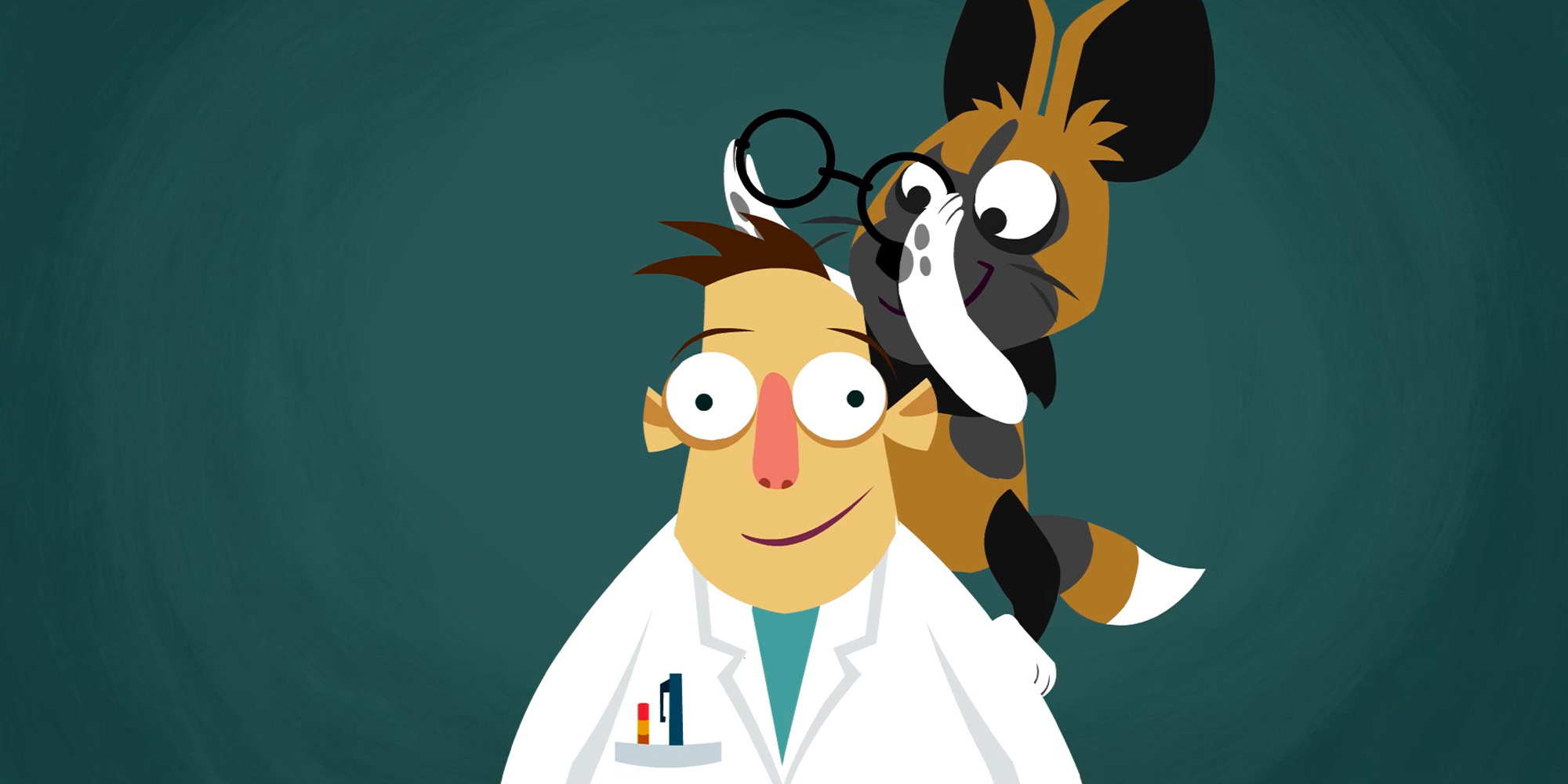


African poachers hide thousands of deadly snares each day to catch antelope, but endangered painted dogs are often caught and killed instead. Dr. Greg Rasmussen innovative collar helps protect the last 4,500 dogs.
DonateThe pups actually are are great fun though. They spend a course of hours and hours playing and and um one dog will every day have to sleep near the pups cuz someone’s got to make sure that they don’t do goofy things. Snares. And now the snares that are set for painted dogs, they’re like a noose, a wire noose that’s set like this at about that height. They’re very cleverly disguised. And then they use branches and grass to hide them. You can’t see them. It just closes and it gets tighter and tighter and tighter and tighter until the animal’s strangled. And it’s a very horrible, miserable way to go.
Basically, the collars are going to work like this. The animal gets um snared, the wire goes here, and if the wire is catches in here, basically the dog will not get caught. So, the wire catches on this metal plate. The dogs, incidentally, is so strong, they always break the wire. And we’ve had domestic dogs testing these collars, and it 90% of the time it’s catching the wire. Until
I started working with painted dogs, nobody knew that they looked after they’re sick and they’re weak and they’re injured because they’ve got this incredible social system where every dog helps every other dog. But I remember a pack a lion mauled one of my young a young dog. And lo and behold, three months later, the pack dragged that dog away. They licked his wounds clean. They looked after him. And I’m like, what other species in the wild does this? Actually takes care of their sick. I had a dog I I called him Miguelan. And Miguelan was like was the run of the litter. But the pack didn’t treat him like the run. He always was given as much food by the rest of the pups.
And when he was an adult, he was always lost on the hunts. But when he came late on the hunt, they they’d give him food. When it came to babysitting time, guess who got the job? You know, Miguel was the babysitter. And they’re just so good at switching roles, switching jobs. The other thing is that they never fight. You never see arguments within the pack ever. You know, they’ve got these enormous ears, the great big big ears, and this will make Mickey Mouse jealous, you know, exceptional. And when they’re running, when they’re running on on a chase, they keep their ears forward. Now, you think they flap them back for speed, but if you’re going to overheat, and the ears actually catch the air that they’ve got almost like a fan running when they’re running. And and the reason they’re called painted dogs, of course, is because no two are the same. an exceptional camouflage.
So, raising money for these collars to keep some packs alive, at least as many as we can. To raise you, one of these collars as it is, it be about $250. For about $500, we’ll be able to have the same thing, but with good electronics in that will really say where you were, what you’re doing. With the solar power on here, these collars will almost last for six or seven years and still be giving information. So, we need to know where these animals are going, even where they’re picking up the snares and say no more building in that area or we can’t have that highway going through there. We need to know how they’re using the landscape. And we need these things. We’d like your help to raise money for these collars and for the dogs because wildlife doesn’t have a voice. The dogs don’t have a voice. They need our voice. And I’d like to thank Endangered Species Revenge for their help in taking the voice of the painted dog to you, the audience.
An Extraordinarily Harmonious Society
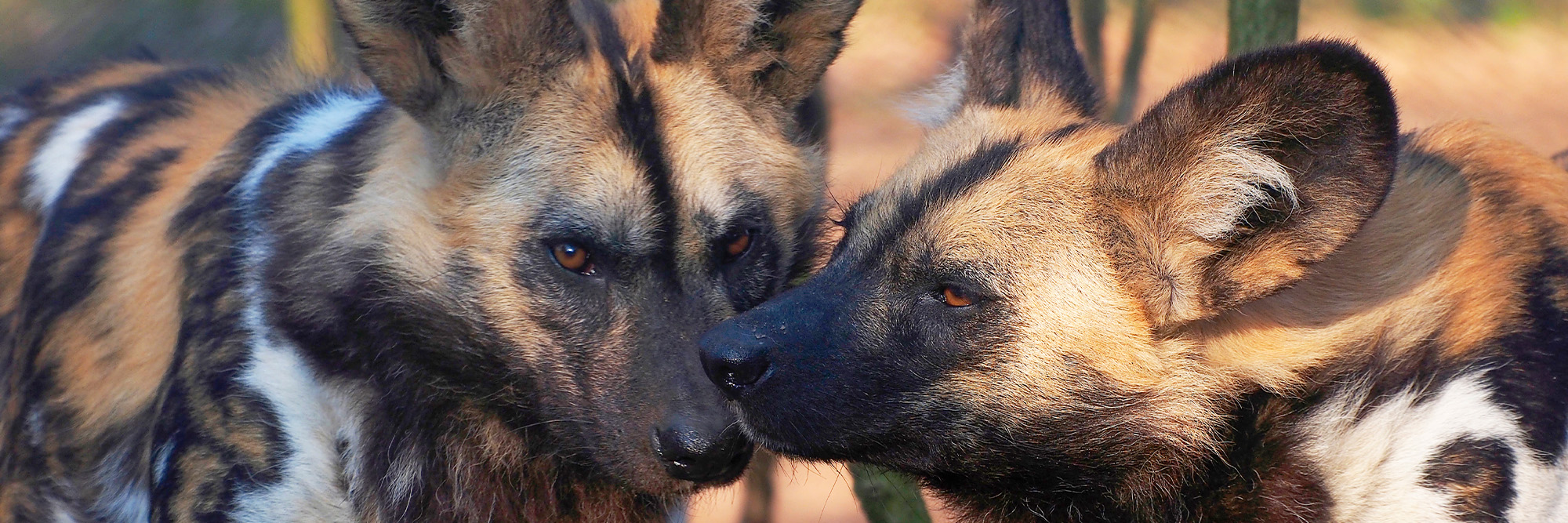
Painted Dogs are some of Africa’s most beautiful animals—with no two dogs having the same calico fur pattern of orange, black and white. They also have gigantic ears—which would put Mickey Mouse to shame! But what is most incredible about them—is undoubtedly the teamwork of their packs, in which every dog has a job, and every dog helps every other dog. Sadly, due to intentional killing by human ranchers, and indirect killing by other human activities, the number of painted dogs has decreased dramatically, and only 4,000—7,000 remain.
In many ways, painted dog society is more equitably and more advanced than human society!
First, the dogs are never right within their packs, because they all agree to follow the lead of both the alpha males and the alpha females. And even if an alpha gets injured, the rest of the pack waits for that dog to heal, and reassumes his position as the alpha—instead of another dog staging a coup to become the new alpha! Also advanced, is that female dogs choose their alpha male by the male’s intelligence—not by who is the biggest and strongest.
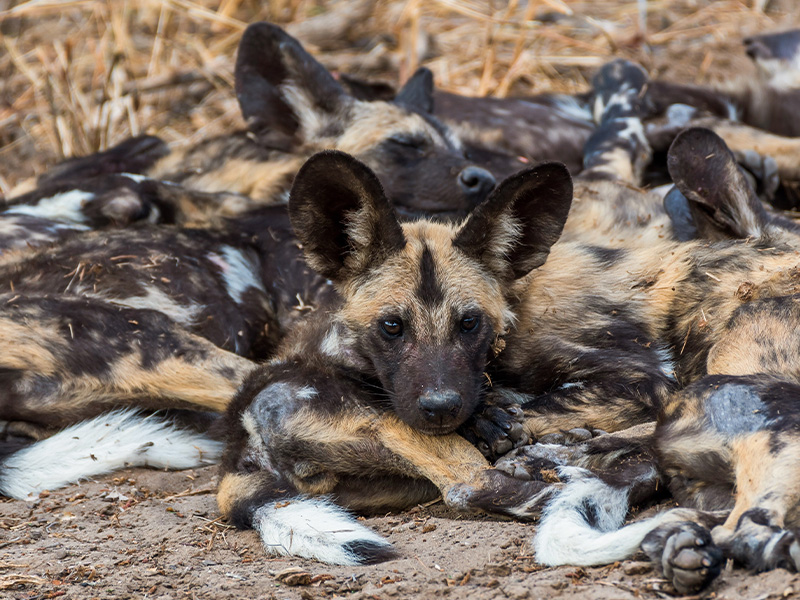
Second, to reinforce strong social bonds within the pack, every morning every member of the pack touches noses with every other member of the pack, to say “Hello,” in a chaotic scene. And all of the pups in the pack sleep on top of each other, touching many fellow pups at once, in what is called a “sleep heap.” Both of these cute actions reinforce social bonds, and act to prevent conflict within the pack.
Third, painted dog packs never fight other packs. If two packs draw near each other, the packs will simply mark their territory and keep moving, so that there is no conflict.
Finally, the society is remarkable in that each gives a role to each dog, no matter how weak or strong that dog is. And in this way, all the dogs in the pack help the pack survive and thrive. For example, the most athletic dogs go on the hunt, and bring back their catch to share first with the elderly, young, sick, wounded or clumsy—while the clumsy dog babysits the vulnerable pups. The hunts by packs are highly coordinated and efficient.
Why Painted Dogs are Endangered
Unfortunately, painted dogs are critically endangered for many reasons—all of them due to humans.
First, just like many wild canines around the world, such as wolves, painted dogs are killed by ranchers, who wrongly blame them for killing more of their livestock than scientists have shown they actually kill.
Second, painted dogs are killed by metal wire snares which poachers trying to catch game meat such as antelopes, skillfully hide along the natural, worn trails that antelopes use daily. Sadly, painted dogs, who use these same trails, often get caught in these snares, which strangle them.
Thirdly, painted dogs also die from rabies and distemper when infected by regular dogs.
And finally, painted dog populations are decreasing due to habit loss, as human society continues to expand into the dogs’ former range.
Greg Rasmussen’s Urgent Efforts to Save Them
Fortunately, Dr. Greg Rasmussen, one of the world’s foremost, passionate painted dog conservationists, is working non-stop to save them. Greg famously survived a near-fatal small plane crash in 2003, alone in the bush for days, unable to move his shattered legs, and surrounded by a lion—which was featured on the TV series “I shouldn’t be alive.”
Founded in 1987, Greg’s organization, Painted Dog Research, has dedicated itself to the long-term scientific research of painted dogs in Zimbabwe, Zambia, Botswana, Namibia and South Africa. Local people are involved in all of the PDR’s conservation efforts, and are educated to continue Greg’s work into the future.
One of Greg’s major efforts to save painted dogs includes fitting the dogs with inventive collars to protect them from being strangled by wire snares.
He also oversees the efforts of anti-poaching teams which remove new wire snares left by poachers every day—then give these wires to local craftspeople who, together with black, orange and white beads, skillfully turn them into sculptures of painted dog to raise funds.
Finally, Greg continually tracks the movement and behavior of painted dog packs, sometimes by tracking pack members fitted with GPS collars – to increase the scientific community’s understanding of the dogs, and to aid conservation efforts.